Chapter 3: Stick Figures

All the Names W Carry is a memoir that draws on an archive of letters and genealogy research to explore how patterns of addiction, mental illness, and silence appear across generations and in my own life.
← Chapter 2: The Last Screw | Part One TOC | Chapter 4: Dream Come True →
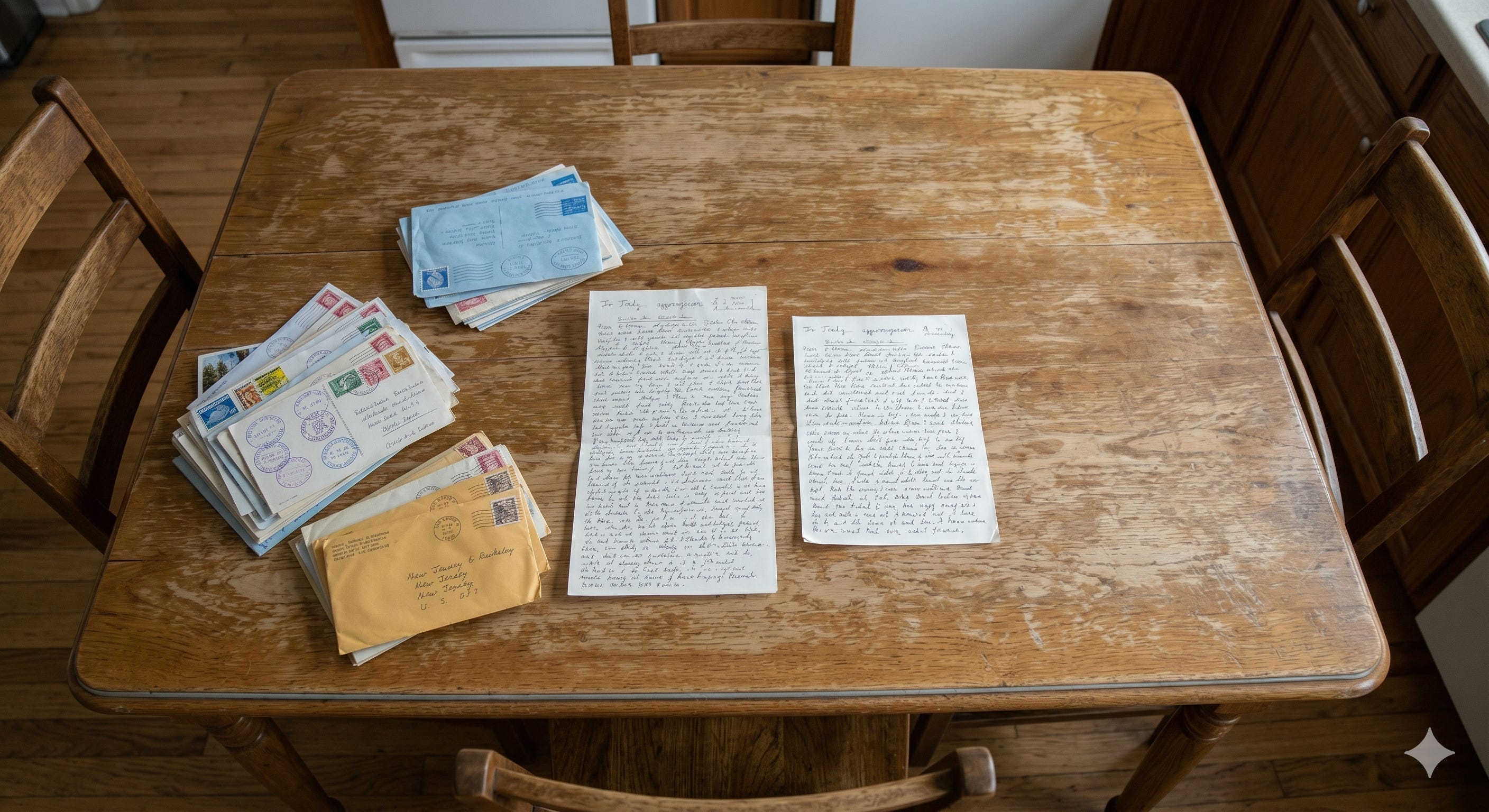
Most of the letters date from the 1970s. They chart the relentless cycle of my family’s life: transportation logistics, financial strain, weather extremes, house maintenance, pet misadventures, and my childhood illnesses, which appear with alarming frequency.
Soon I’m spending my days reading each letter aloud into a microphone, archiving them on a website. I send the link to my sisters, and before long they’re calling almost daily—sometimes laughing, sometimes crying, sometimes stunned by things they’d never fully understood until now.
They begin unearthing their own letters, from closets and attics and drawers, and the past becomes louder. Little by little, the full picture comes into view: a constant hum of background stress that accompanied even our happiest moments, woven together with culinary pleasures, a shared love of music, family jokes, and enduring affection.
“What happened to that person?” Chris asks me after I read her a jaunty, humorous letter she wrote to Diane in 1981. I hadn’t expected it to stir in her regret for a woman she no longer recognizes. But I also understood. I miss that version of her too.
The letters on my kitchen table are stamped with a colorful array of place names: Barcelona. Madrid. Paris. Rome. Heidelberg.
They date to the summer of 1971, when my two oldest sisters, Sue and Diane, went backpacking in Europe. The two were more than sisters. They were best friends. “On train, both thinking of home at the same time,” Diane wrote in her journal about Sue. “Always thinking same thoughts…It’s weird. We really don’t have to talk to get an idea across.”
I pick up one of the faded blue aerograms and examine its folds and delicate onionskin paper before prying it open.
Inside, handwriting fills the paper edge to edge.
In Italy, they complain about aggressive men in “tiny, tiny cars,” and insist that my mother’s spaghetti and meatballs are “far superior” to anything they have eaten there.
In Strasbourg, they forget to validate their rail passes, get kicked off the train, and spend a night cold, hungry, and miserable before declaring the whole experience “pretty funny.”
Austria is “indescribably gorgeous.”
While traveling through Spain they asked after me. “We miss Amy so much. Every time we see a little kid or some baby close by, we shed tears. Well…we sniffle a little.”
It was Diane who forced my mother to admit she was expecting when, in a moment of adolescent rage, she told her she looked fat.
“I’m pregnant,” my mother said.
It was May. She was due in July.
By the time I was born in 1970, Diane was a senior in high school; Fran and Joe were close behind. Chris was ten. Sue had recently dropped out of her first year of college. She was the most perturbed by the new pregnancy, due to her concerns about overpopulation.
My mother had always claimed that if the twins had not been stillborn, she might not have had Chris and me. “I always wanted six children,” she’d explain, as though it were simple arithmetic.
One letter in the pile of aerograms looks different from the rest. As I unfold it, I see it’s written in my mother’s hand.
“Greetings from Oceanport, New Jersey!” she begins. “I am so excited about writing to you in Europe I can hardly hold the pen straight!”
She tells them the family is savoring their correspondence “as though it were one of the great European wines you mentioned.” She updates them on my father’s furniture projects, the new drapes and slipcovers, our leaking boat, the Comet, that “almost sank,” and Pop’s contribution of $100 sent by cable. “Please write him a letter when you receive it.”
“Sweet baby Ames is really coming along. She is now a toddler. Yes, she walks all over the house, falls down and goes boom, gets up, and starts all over again. As you can see, today is the day after her birthday,” she notes.
“She had a very nice day. We bought her some push-and-pull toys and a pretty doll. She ooh-ed and aah-ed when she saw them, played with them for about ten minutes, and then went back to the cupboard to play with the pots and pans, and then onto the garbage bag to see what she could come up with there.”
“I know, she misses you because when I say, ‘Where is your Diane and Susie?’ she becomes very thoughtful and looks so sad.”
At the end of the letter, she draws a group of stick figures representing the entire family, each with their own speech bubble:
Pop, in his Croatian accent, asks, “Vy you so far avay?”
Dad wonders when they’ll be done “gallivanting.”
Mom gushes, “So glad you like my spaghetti more than Italy!”
Fran writes, “I have nose—I mean news—for you!”
Joe says, “Take it easy.”
Christine offers a simple, “Love ya.”
Baby Amy thanks them for the birthday sweater from Germany, and says, “Ba Ba Da Ma.”
← Chapter 2: The Last Screw | Part One TOC | Chapter 4: Dream Come True →