Chapter 6: Glad Tidings

← Chapter 5: Death Was in the Barn | Part One TOC
Everything I’ve ever known about my sister Fran has been filtered through the glassy mirage of childhood memory and second-hand accounts. The letters, photos, and her own journals have helped me piece together a version of her I didn’t know existed.
In black-and-white photos from before I was born, Fran is a pretty, thoughtful-looking little girl with long eyelashes, pouty lips, and long wavy brown hair. Her grade-school report cards describe her as well-behaved and bright. Outside of shyness, teachers noted nothing unusual. “Perfectly normal,” recalled my brother Joe when I asked him what she was like then, years ago.
When Fran and Joe were in their early teens, my parents took them out of public school and enrolled them in the parish school. The church needed pews; my parents needed structure for their rebellious teenagers. It was a practical exchange, though my mother would come to believe that sending them there had been one of the family’s great mistakes, as though the church had somehow taken hold of her children and returned them changed. She was so convinced of this, in fact, she decided never to attend Mass again.
Growing up, I heard whispers about what had happened at Little Flower, but Joe always maintained that the Catholic school had “nothing to do with” the way he or Fran turned out. There were no horror stories of discipline and humiliation. In fact, one of the nuns, Sister Georgette, was actually his favorite teacher. She called him “angel face” and, according to Joe, let him get away with more than she should have, even though she knew exactly what he was: a troublemaker.
They were rebels already, he believed. They hated rules and uniforms. He insisted that Fran, not him, was the instigator of most of their shenanigans, including one audacious plan to hurl their street clothes out the second-floor window of the apartment, then march into class to the horror of the nuns—Fran in a miniskirt, Joe in tight white pants and boots, “like the Beatles.” Ultimately, though, it was Joe’s decision to throw a firework at the school’s gym teacher that got them both kicked out.
Whatever role Little Flower may or may not have played, those who knew Fran all agreed that, by adolescence, something wasn’t quite right.
Sue told me that on a shopping trip to an electronics store, Fran needed to touch every television in the store before she would leave. In Oceanport, where she and Chris shared a bedroom, they practiced a nightly ritual: closets checked, then words repeated until Fran was satisfied:
“Uncle Fester, Uncle Fester, Uncle Fester.”
Uncle Fester—the fictional Addams Family uncle—was the family misfit. Odd, unpredictable, tender, and misunderstood.
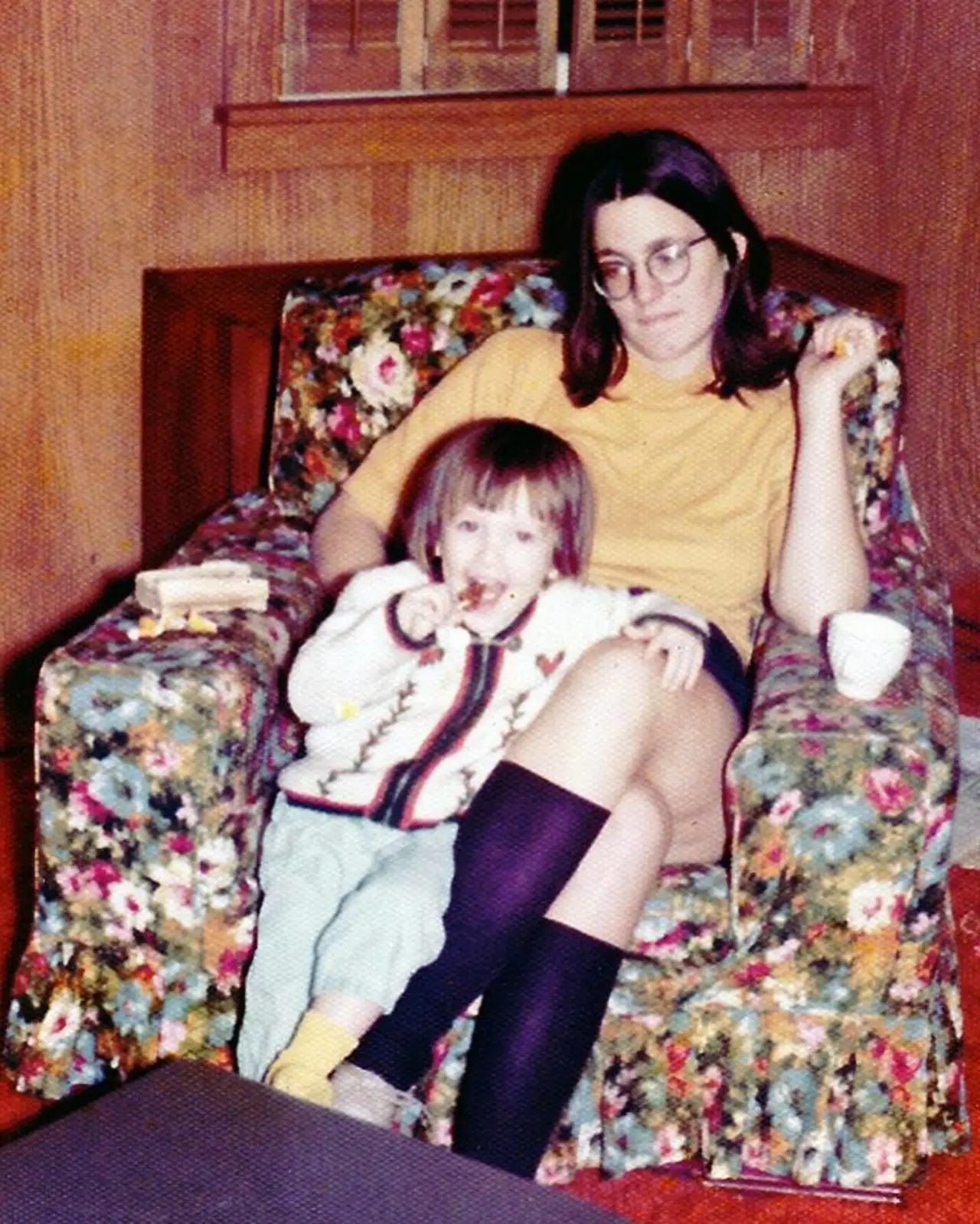
I have a photograph of her sitting in a gloomy, flower-print armchair pushed up against dark wood paneling. I can see the flashbulb’s reflection in her large, thick eyeglasses. Her elbow is propped nonchalantly on the armrest beside a delicate white china cup. In front of her, barely taller than the seat cushion, is me in an embroidered cardigan and blue jeans. I can’t be much older than three, which would make Fran about nineteen.
My left arm is draped casually over her knee; in my other hand I hold a lollipop halfway to my smiling mouth.
When I look at this photograph, it seems impossible that she once sat in that chair, that I was ever that small, that I loved her. That she even existed.
For me, even though she was sixteen years older than me, Fran was a playmate. She helped me learn the alphabet, how to draw faces and stick figures, and how to play card games like Go Fish, Slapjack, and Gin Rummy.
Sure, sometimes she laughed at strange moments, stared too long at nothing, or stepped away abruptly. And once she betrayed me by revealing something I’d told her in confidence.
“Amy likes the smell of her own farts,” she announced at the dinner table one evening.
But she needed me. And I loved her, even if I didn’t understand her.
One evening, we were playing when Fran suddenly dropped to the floor. She writhed, moaned, and cried. Frightened and confused, I kicked her hard in the small of the back as she lay there. She had changed on me.
Fran cried out, and my mother came running. “Fran is sick,” she said.
As if that would explain everything.
Fran slept in the rear bedroom on the southwest corner of the house facing the river, a sunny yellow room with a flower-print bedspread. But something about the yellow room made her uneasy, so she decamped to the living room couch, which is where I always think of her: spread out on the green velvet, wrapped in a blanket, often with a book in her hands.
If Fran was looking for safety and salvation, she wouldn’t find it at home.
After high school she joined a born-again church in Tinton Falls—Glad Tidings Assembly of God—where she found a ready-made community. It was the kind of place that offered warmth, music, and the promise of a savior. A photograph of Glad Tidings members published in the Asbury Park Press shows men and women who looked a lot like Fran did then: long, straight hair, embroidered tops, bell-bottoms.
As Catholics, my parents were not pleased.
“You don’t go out and convert people,” they said.
To them, being born again meant someone else had assumed authority over their child, and they had tried that once already. This time, Fran’s rebellion took the form of proselytizing.
“Francie says she’s going to get a tattoo to testify to Jesus,” Diane wrote in her journal in April of 1975. “She says if she doesn’t, there’s no reason to be a Christian.”
“She thinks—she believes, truly believes—that she is the only person who knows God… She is so humble and holy and disgusting!”
In July, my mother gave Fran thirty days to get off the couch, pack her bags, and move out. Sue stepped in to help, suggesting that Fran could rent a room in Asbury Park for forty dollars a week. Fran was excited at first and went to see it, but her enthusiasm evaporated the moment the possibility became real.
“She’s very depressed,” Sue wrote to Diane. “She wants more than anything to move out of that house where she feels unwanted and despised.”
But she struggled to make decisions on her own.
“She wants someone—a husband?—to take over and make all the decisions for her.”
Diane tried to offer advice and encouragement from Vermont.
“You’ll be able to sort things out so much better when you are dependent only upon yourself,” Diane assured her in a letter.
Months later, Fran was still at home and sending ordinary updates to Diane. Her letters focused on books and music and were delivered in plain, flat language: the purchase of a new Bob Dylan album, or the surprise of finding Turn! Turn! Turn! by the Byrds for $2.99 to replace a copy she had lost.
“I’m glad you’re happy,” she wrote to Diane as she closed one of her letters, then offered a small glimpse of home life.
“Today, Mom, Joe, and I feasted on pancakes, and we used the maple syrup that you brought from Vermont. It was very good.”